
Every web studio will offer some version of a free consultation. Most of them are the same thing wearing different names: a call where a salesperson asks a few surface-level questions, skims the homepage, and pivots quickly into a pitch for services. Nothing wrong is technically identified. Nothing built on. The call exists to close, not to inform.
That distinction is easy to miss because both versions can look identical on the surface. Both get booked through the same kind of “free strategy call” link. Both last roughly the same amount of time. Both end with some kind of next step. The difference only becomes clear in the substance of the conversation itself, and by the time a business owner realizes which version they got, they've often already made a decision based on it.
A genuine strategy session is a different exercise entirely, and it's worth knowing the difference before agreeing to one by setting the right expectations and recognizing when a business is getting the real version versus the sales-call version wearing its clothes.

It Starts With the Site, Not the Pitch
The clearest tell of a genuine review is where it begins. A sales call begins with questions about budget and timeline, because the goal is to get to a proposal. A real strategy session begins with the site itself such as actual performance data, actual visitor behavior, actual conversion paths, because the goal is to understand what's happening before anyone talks about what to do about it.
That means the session should be grounded in something concrete: traffic sources, page-level engagement, where visitors drop off, how the site performs on mobile versus desktop, what's ranking and what isn't. A studio that skips this step and moves straight to recommendations is working from assumptions, not evidence, and recommendations built on assumptions tend to solve the wrong problem well.
What Actually Gets Reviewed
A thorough session covers more ground than most business owners expect from a single conversation. At minimum, it should include:
Performance and technical health. How fast the site loads, how it behaves on mobile, and whether there are technical issues quietly suppressing search visibility or frustrating visitors before they ever see the content.
Conversion paths. Whether the site actually guides a visitor toward a specific action, or whether that path is muddled, buried, or missing entirely. A beautiful site that doesn't clearly ask for anything is a beautiful site that underperforms.
Content freshness and relevance. Whether the site reflects the business as it exists today in terms of current services, current positioning, current proof points, or whether it's quietly representing an earlier version of the company.
Competitive positioning. How the site compares to what serious competitors in the same space are doing, not to justify a redesign for its own sake, but to identify where the business is genuinely being outpaced online. This isn't about chasing every competitor's design trend but rather it's about identifying specific, meaningful gaps: a competitor with a clearer service breakdown, a faster site, a more credible case study section, or a conversion path that's simply easier to follow.
Trust and credibility signals. Whether the site actually communicates the caliber of the business behind it through case studies, client results, clear expertise, and the kind of specificity that distinguishes a serious operator from a generic service provider. A site can be technically sound and still fail to convey why a visitor should trust this particular business over any other.
This is also where a review earns its value as an optimization exercise rather than a general impression. Research from HubSpot has found that conversion rate optimization is one of the most widely used optimization techniques among marketers today, trailing only audience segmentation refinement by a single percentage point, a reflection of just how central structured conversion review has become to how serious marketers actually improve results, rather than guess at them.
The Questions a Real Session Asks
A sales call asks questions designed to qualify a lead: What's your budget? When do you want to launch? A strategy session asks questions designed to understand a business: What's actually driving revenue right now? Which service or offering is growing? Where do prospects usually get stuck before they reach out? What does a good lead actually look like, and is the site currently attracting them?
These aren't small-talk questions. They're the foundation for every recommendation that follows, because a website recommendation that isn't grounded in what the business actually needs is just an opinion about design. The quality of a strategy session can often be measured by how much time it spends on the business itself, relative to how much time it spends on the website in isolation.
What a Real Session Should Produce
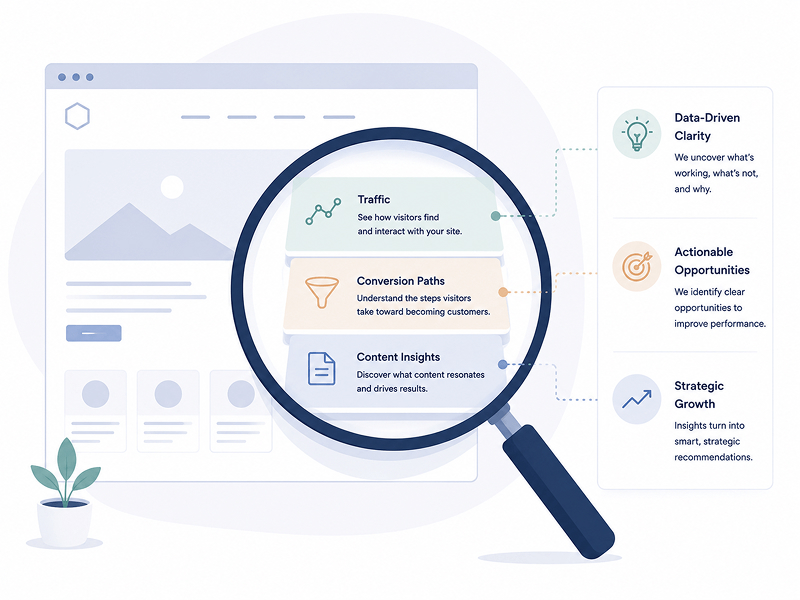
The output of a genuine review isn't a proposal. It's a prioritized understanding of where the site is strong, where it's leaking value, and what would move the needle most if addressed first. A business owner walking away from a real session should be able to answer: what's working, what isn't, and what the highest-leverage next step actually is regardless of whether they move forward with the studio that ran the session.
That last point matters more than it might seem. A session designed purely to generate a sale will shape its findings around what the studio wants to sell. A session designed to genuinely help the business will hold up on its own, whether or not the business ultimately chooses to work with that particular studio. This is a useful, if slightly uncomfortable, test to apply after the fact: would these findings still be true and still be useful if evaluated by a completely different studio?
How This Differs From a Sales Call, in Practice
The distinction often comes down to specificity. A sales-oriented consultation tends to speak in generalities in terms of your site could convert better, your design could feel more modern, your SEO could improve. All of that may be true, but none of it is actionable, because it isn't tied to anything concrete about the actual site or the actual business.
A genuine strategy session speaks in specifics: this particular page has a high drop-off rate before the contact form, this service page hasn't been updated since a positioning shift that happened over a year ago, mobile visitors are converting at a fraction of the rate desktop visitors are. Specificity is a signal of real diagnostic work. Vagueness, however polished the delivery, usually signals a pitch dressed up as an audit.
It's also worth paying attention to how a studio handles a finding that doesn't point toward more work. A genuine reviewer will sometimes conclude that a site's foundation is actually solid and that a smaller, targeted fix would serve the business better than a larger engagement. A studio that always finds a reason for a bigger project, regardless of what the data actually shows, is optimizing for its own revenue rather than the client's.
Why a One-Time Review Isn't a Substitute for Ongoing Attention
It's worth being clear about what a strategy session is, and what it isn't. A single review, however thorough, is a snapshot. It captures where the site stands at a specific moment, which is valuable, but it doesn't replace the kind of continuous attention that actually keeps a site improving over time. A business that gets a sharp, honest review once a year and otherwise has no one watching the site in between is still, for most of that year, operating without the strategic oversight the review itself demonstrated the value of.
This is why the most useful way to think about a strategy session is as a starting point rather than an end point. It establishes a baseline, surfaces the highest-priority issues, and gives the business owner a clear-eyed view of where things stand. What happens next, whether that's a set of targeted fixes, a broader project, or an ongoing relationship that keeps revisiting these same questions on a regular cadence, is where the actual improvement happens. The review identifies the gap. Closing it is a different, ongoing effort.
What to Bring to the Table
A strategy session works best when it isn't a passive presentation. The business owner has context a studio can't get from analytics alone which leads tend to be highest quality, what a good customer actually looks like, which offerings are becoming more or less central to the business, and what's changed since the site was last meaningfully updated. Bringing that context into the room, rather than waiting to be asked, tends to produce a sharper, more useful session.
It's also worth arriving with a genuine question in mind, rather than simply waiting to hear an opinion. Is the site actually representing the business accurately anymore? Is it generating leads that convert into the kind of clients the business actually wants, or just traffic? Would a prospective client, landing on the site cold, get an accurate sense of the caliber of the business behind it? A session anchored to a real question tends to surface more useful answers than one that starts from nothing.
When It Makes Sense to Ask for One
A website review is worth requesting any time there's a gap between how a business is performing and how its website is performing, for example, when leads have slowed, when a competitor's site suddenly looks sharper, when the business itself has evolved in ways the website hasn't caught up to, or simply when it's been a long stretch since anyone looked at the site with real scrutiny rather than routine maintenance in mind.
It's also the natural next step for a business owner who has already recognized, through an honest look at whether their current web partner is the right fit, that the arrangement isn't providing this kind of strategic attention. A review doesn't have to mean starting over. Often it simply means finally getting a clear, evidence-based picture of where the site stands which is the necessary starting point for any decision that follows, whether that's a handful of targeted fixes, a deeper ongoing partnership, or a more significant rebuild.
What would a real review of your website actually reveal, and when was the last time someone gave it that level of attention? Whether your site has been quietly coasting, you're evaluating a new web partner, or you simply want an honest, evidence-based picture of what's working and what isn't, a genuine strategy session is the place to start. Let's take a real look at your website together.
Sources and Further Reading
HubSpot — 2026 Marketing Statistics, Trends & Data