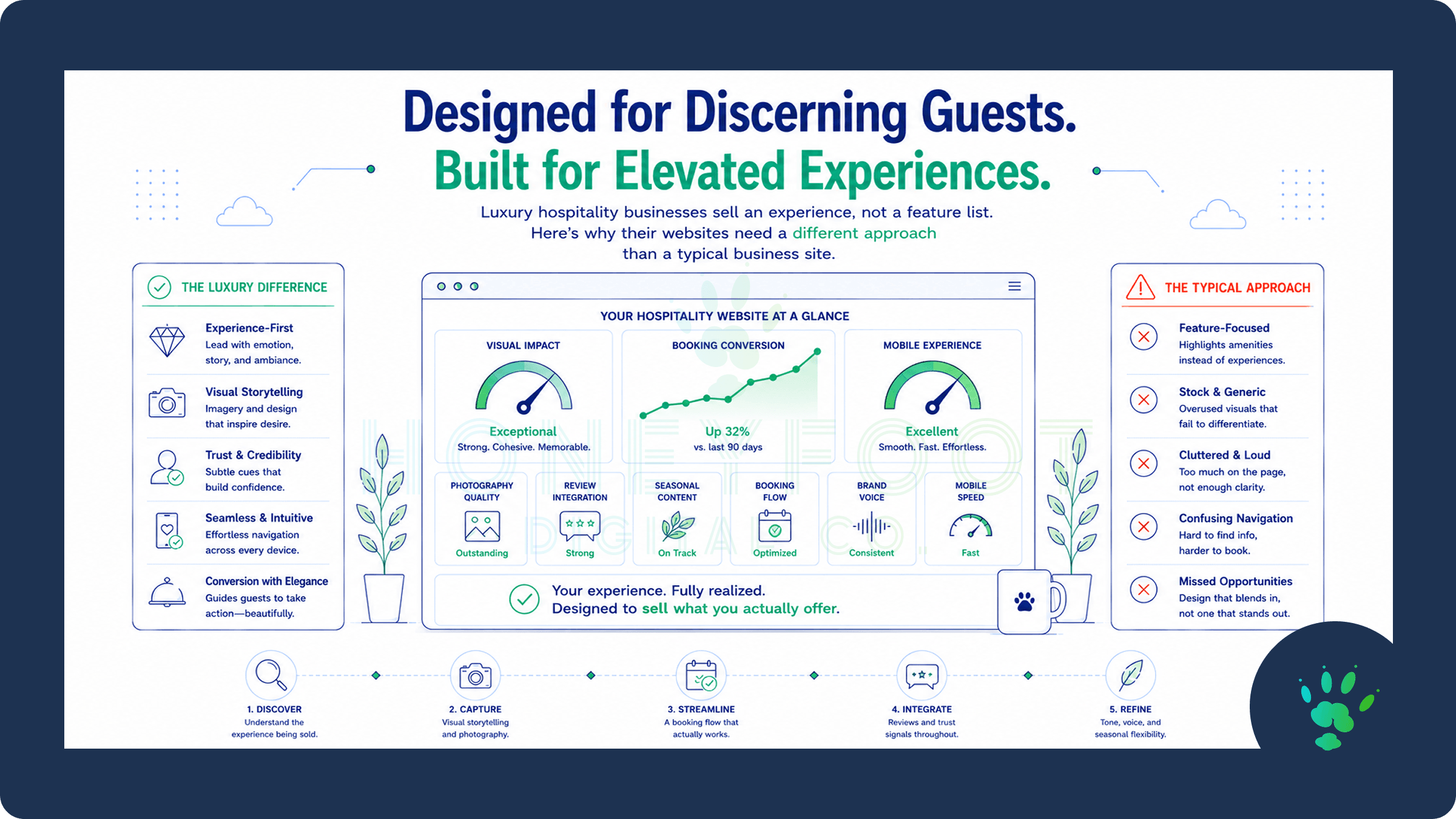
Generic Templates Weren't Built for What These Businesses Actually Sell
Most website design advice is written for a generic business: a service company selling a defined offering to a rational buyer comparing options on price and features. That advice isn't wrong, exactly. It's just built for a different kind of purchase than the one a boutique hotel, a high-end spa, a private chef, or a luxury event venue is actually asking someone to make.
Hospitality and luxury service businesses aren't selling a feature set. They're selling a feeling, an experience, and a level of trust that has to be established before a visitor ever sets foot on the property or picks up the phone. A website built with the same assumptions as a generic B2B service site will technically function for a hospitality business. It just won't do the actual job the business needs it to do.
The gap between “technically functional” and “actually persuasive” is where most hospitality businesses lose the most value online, often without realizing the website itself is the reason. A visitor who leaves without booking rarely leaves a note explaining why. They simply move on to the next option, one that may have communicated the same quality of experience more effectively, even if the underlying offering wasn't actually better.
Selling an Experience, Not a Product
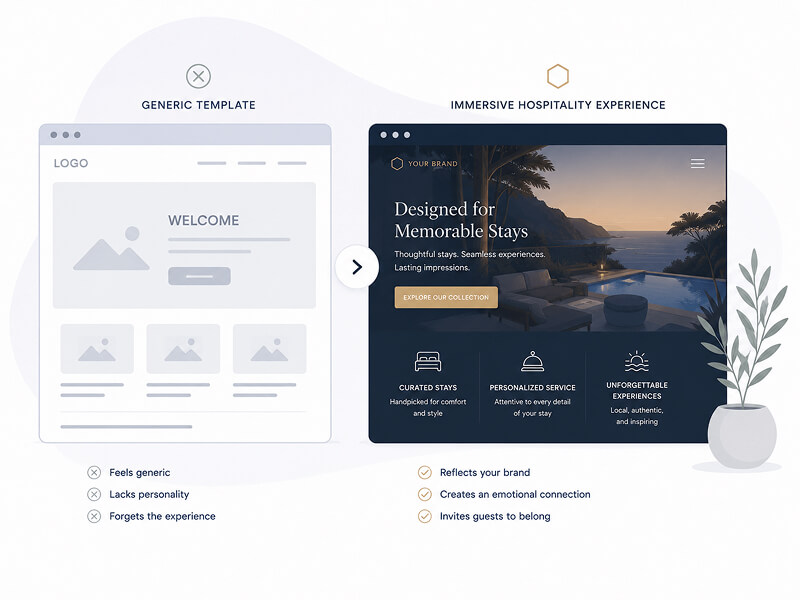
A software company can describe its product in a bulleted feature list and let the buyer evaluate it logically. A luxury hospitality business can't do that, because what it's actually selling can't be reduced to a list. A boutique resort isn't selling square footage and amenities. It's selling what it feels like to arrive, to be received, to spend three days somewhere that feels considered down to the last detail.
This means the website itself has to do more emotional work than a typical business site. Photography, pacing, whitespace, and the overall sense of atmosphere aren't decoration layered on top of the content. They are the content, in the sense that they're doing the actual persuading. A hospitality site with generic stock photography and a standard service-page layout is asking visitors to imagine the experience the business is trying to sell, rather than showing it to them directly.
The Booking Path Is Genuinely Different
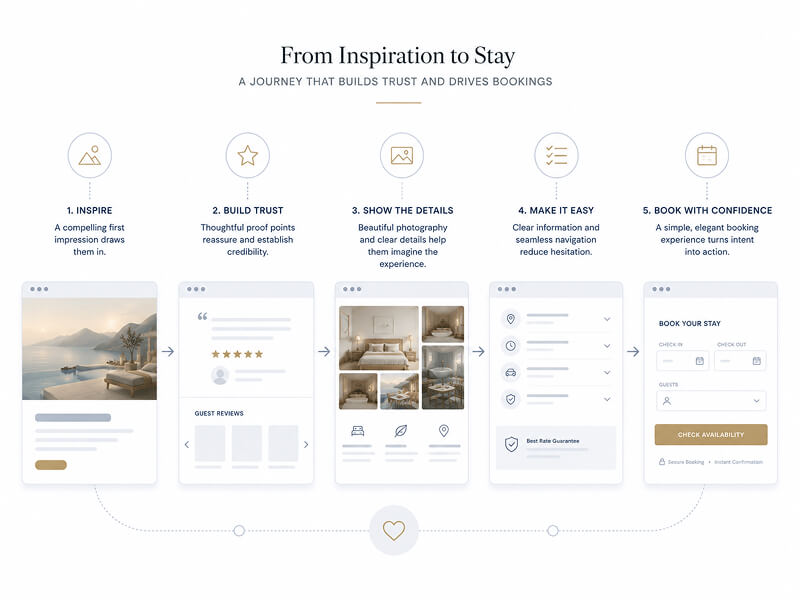
Most business websites are built around a single, simple conversion action: fill out a contact form, request a quote, schedule a call. Hospitality and luxury service businesses often need something more complex, because the actual transaction involves dates, availability, deposits, party size, and sometimes multiple decision points before a booking is confirmed.
A generic contact form asking for a name, email, and message is a poor substitute for a booking flow that actually reflects how these businesses take reservations. Friction in this specific path costs more than friction elsewhere on a typical site, because the visitor who reaches this point has already decided they're interested. Losing them here, to a clunky or unclear process, is losing a warm lead at the most expensive possible moment.
This is also where the gap between industries becomes most visible in practice. A software company that makes a prospective buyer wait a day for a follow-up email loses relatively little, because the buyer's evaluation process was already going to take time. A hospitality visitor comparing several properties for the same weekend is often making a decision within minutes, and a booking process that feels uncertain, slow, or unclear is enough to push that decision toward a competitor with a smoother path to confirmation.
Trust Has to Be Established Before a Much Bigger Commitment
A luxury hospitality purchase is rarely a small, low-stakes decision. A weekend at a boutique property, a private event, a bespoke service experience: these carry a higher price point and a higher emotional stake than most transactions a typical business website is asking a visitor to make. That changes what the site has to accomplish before someone is willing to commit.
Generic trust signals, a short About page and a few testimonials, tend to be insufficient here. What actually builds trust for this kind of purchase is specificity: real detail about what the experience includes, clear and current reviews, a sense of who is actually behind the business, and visual proof rather than description. This is often the difference between a visitor who reads a page and moves on, and one who feels confident enough to commit to a significant purchase from a business they've never physically visited. HubSpot's own research on content marketing consistently finds that visual and experiential content drives meaningfully more engagement than text-based claims alone, which tracks directly with how a hospitality visitor actually evaluates a business before committing to a significant purchase.
Seasonality Changes What the Site Needs to Do
Many hospitality and luxury service businesses experience real seasonal shifts in demand, and a website built as a static, unchanging asset struggles to keep up. A property that's fully booked during peak season and actively courting demand during a slower stretch needs a site that can flex accordingly: different messaging, different urgency, sometimes entirely different offers, depending on the time of year.
A generic business site, built once and left alone, has no mechanism for this kind of responsiveness. A site built with a hospitality business's actual demand pattern in mind treats seasonal flexibility as a planned feature rather than an afterthought that gets handled manually, inconsistently, or not at all.
Reputation and Reviews Carry More Weight Here
Review and reputation signals matter for nearly every business, but they carry outsized weight for hospitality and luxury services specifically, because so much of the purchase decision is emotional and comparative. A prospective guest deciding between two boutique properties is often making that decision based heavily on what recent guests have said, not just on what the business says about itself.
A website that treats reviews as a small widget buried in a footer is underusing one of the most persuasive assets the business has. Integrating recent, specific, well-presented reviews throughout the site, not just on a single dedicated page, does far more work for a hospitality business than it typically does for a standard B2B service site, simply because of how central social proof is to this particular buying decision.
Visual Quality Isn't a Nice-to-Have
For most business types, professional photography is a meaningful upgrade over amateur images. For a hospitality or luxury service business, it's closer to a baseline requirement, part of what a genuinely high-performing website actually looks like in this category, because the visuals are doing a disproportionate share of the actual selling. A property, a venue, or a curated experience that's photographed poorly is communicating something false about the quality of what's actually being offered, regardless of how good that offering genuinely is.
This extends beyond a single hero image. Consistent visual quality across the entire site, from the smallest gallery thumbnail to the largest banner image, signals the same level of care the business is presumably bringing to the actual guest experience. A visitor evaluating a luxury purchase notices inconsistency here in a way that a visitor evaluating a typical service business simply doesn't.
Mobile Experience Matters More Than the Industry Average
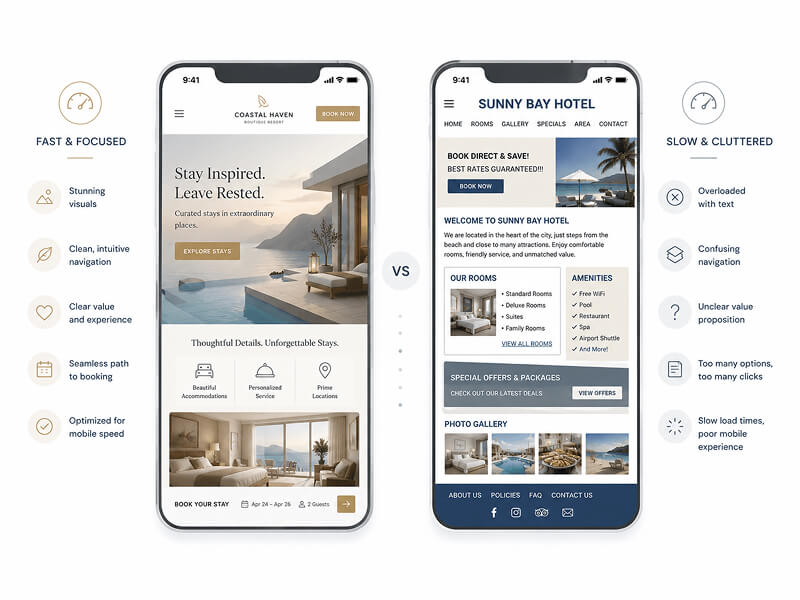
Hospitality decisions are frequently made in moments that don't happen at a desk: scrolling through options while traveling, comparing properties from a phone during a lunch break, browsing a venue late at night while planning an event. A hospitality or luxury service website that treats mobile as a secondary consideration, functional but clearly built for desktop first, is underserving the exact context in which many of its highest-intent visitors actually arrive.
This isn't unique to hospitality in principle. Mobile experience matters broadly. But the gap between a good and a mediocre mobile experience is felt more acutely here, because so much of what's being sold depends on visual impact, and a site that compresses, crops, or slows down its imagery on mobile is undermining the exact thing it's trying to communicate. A gallery that loads beautifully on desktop but sluggishly or awkwardly on a phone is failing at the moment it matters most.
The Language of the Site Has to Match the Experience Being Sold
Tone matters more here than it does for most business categories. A luxury property or a high-end service business communicates quality partly through how it writes about itself, not just through what it shows. Copy that reads like a generic service business, heavy on efficiency and value propositions, works against a brand trying to convey warmth, exclusivity, or considered craftsmanship.
This doesn't mean every word needs to be lavish or overwritten. Restraint is often more effective than embellishment in this category, since overwrought language can undercut the sense of quiet confidence that luxury brands typically rely on. But it does mean the copywriting has to be treated as part of the overall sensory experience of the site, not as an afterthought filled in around the design. A beautifully designed site with generic, forgettable copy still falls short of what this category of business actually needs.
What This Actually Means in Practice
None of this means a hospitality or luxury service business needs a more expensive website in some abstract sense. It means the website needs to be built around a different set of priorities than a generic business template assumes: atmosphere over feature lists, a genuinely functional booking experience over a basic contact form, review integration woven throughout rather than tucked away, and a level of visual consistency that most business sites don't require.
A studio that approaches every project with the same generic framework, regardless of what the business actually sells, will produce a technically functional site that still underperforms for exactly these reasons. Recognizing what makes this category of business genuinely different is the starting point for building a site that actually does the job it needs to do, and it's a distinction that becomes more valuable, not less, the more competitive a local hospitality or luxury service market becomes.
Does your website actually capture what makes your business worth choosing, or is it running on the same generic assumptions built for a completely different kind of purchase? Whether you run a boutique property, a luxury service business, or anything where the experience itself is the product, it's worth having a website that reflects that. Let's talk about what your website should actually be doing for your business.
Sources and Further Reading
HubSpot: 2026 Marketing Statistics, Trends & Data